


Liquidation rights, granted to investors in primary financing rounds, are a defining feature of venture investing. These rights, often referred to as preference or preference stack, are designed to protect an investor’s cost basis. However, they can also have downstream implications for subordinated shareholders. Secondary transactions usually include common and early preferred securities, so evaluating liquidation rights is a critical consideration for any secondary investor. This article provides additional context on liquidation preferences, NewView Capital’s approach to assessing preference risk, and our observations across more than 400 investments in over 90 companies.
When Does Preference Matter?
A large preference stack is not by itself a cause for concern. Most late-stage companies accumulate meaningful preference stacks across primary financing rounds. The more important question is whether that stack is likely to influence economics, incentives, or exit outcomes. A simplified framework can be applied to evaluate whether liquidation rights introduce risk to the investment:
1. Outsized Preference
When preference represents a large percentage of the company’s total equity value, preferred equity holders have an outsized claim to exit proceeds. As this claim – also known as the preference overhang – grows, so does the probability that common shareholders will see diminishing returns at exit. This can occur when a company raises multiple rounds of capital at or near prior round valuations.
A useful proxy for preference overhang is the preference multiple, calculated as total liquidation preference divided by revenue. In a simplified 1x non-participating scenario, this generally represents the approximate revenue multiple that must be cleared before common shareholders begin participating in any proceeds. Below that threshold, exit value is absorbed by preferred claims.
This preference multiple should then be evaluated against the valuation multiple of the company’s highest priced preferred round. The preference multiple tells us when common shareholders will receive their first dollar. The valuation multiple tells us what valuation needs to be cleared for all shareholders to receive proceeds pro-rata. Between these two thresholds, common shareholders may receive proceeds, but preferred shareholders will still capture a disproportionate share of exit value through their liquidation preference. This is best illustrated with a standard liquidation preference waterfall:
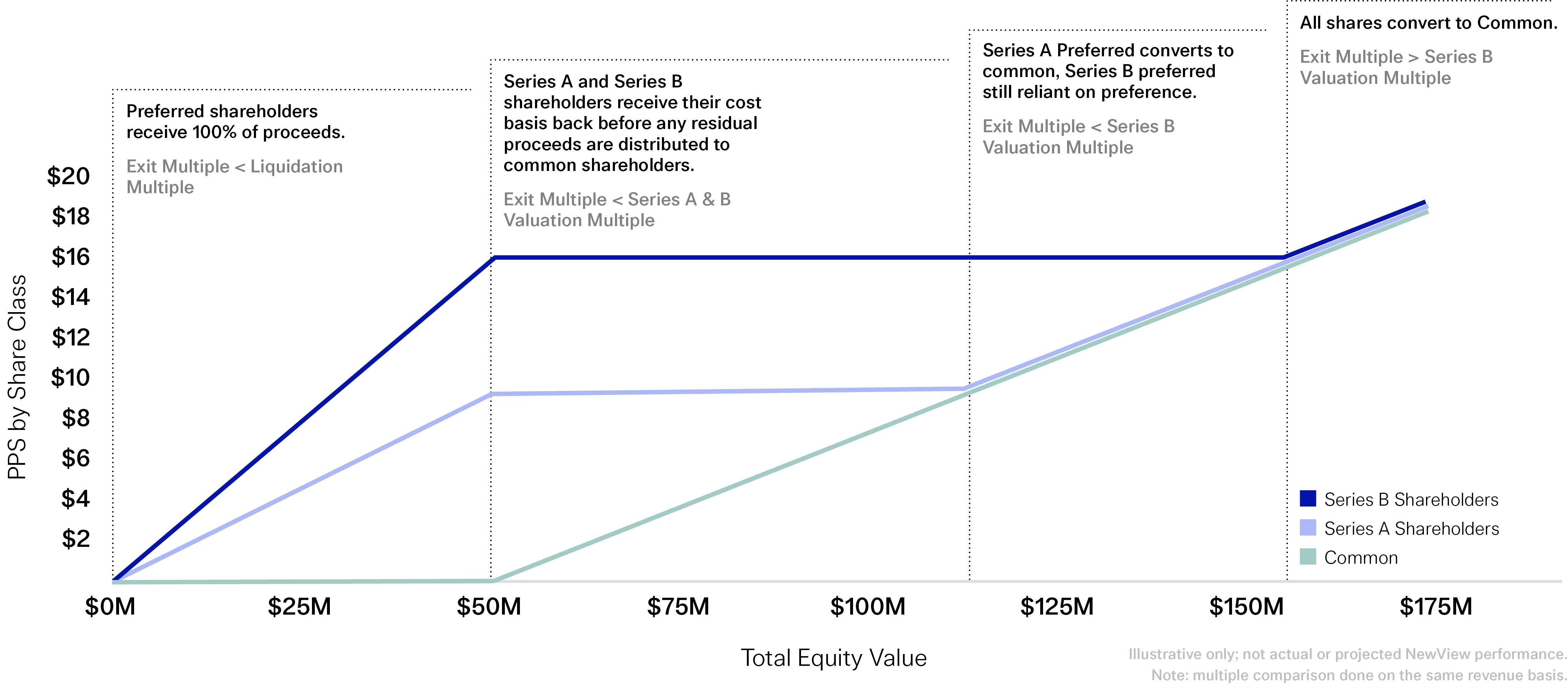
All shareholders have exposure to preference overhang, but with varying degrees of risk, as determined by the varying rights, preferences, and valuations associated with each share class. Because common shares are subordinate to preferred shares in the capital stack, they are the first to face risk from preference overhang. Similarly, early preferred shares purchased via secondary can experience increased exposure if the secondary purchase price per share exceeds the original issuance price of the preferred shares.
For example, a secondary investor who purchases Series A shares for $5.00 per share vs the original issuance price of the Series A preferred shares of $1.00 has a liquidation claim on just about 20% of the investment cost. Across common and preferred share purchases, secondary investors will generally experience capital impairment if the company is sold for below their entry valuation.
Our Approach
We prioritize investments in companies where preference represents a modest share of the equity value or where strong growth and healthy cash balances provide a credible path to outgrow preference overhang.
2. Existence of Structure and/or Seniority
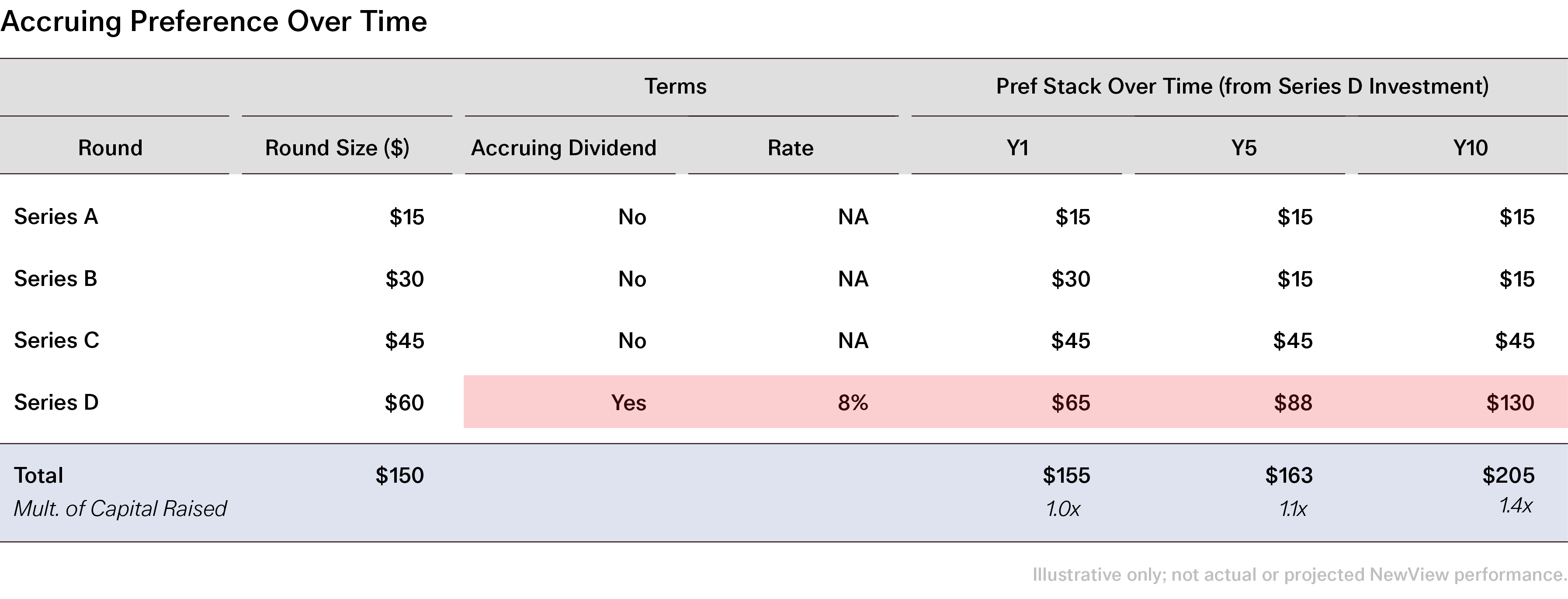
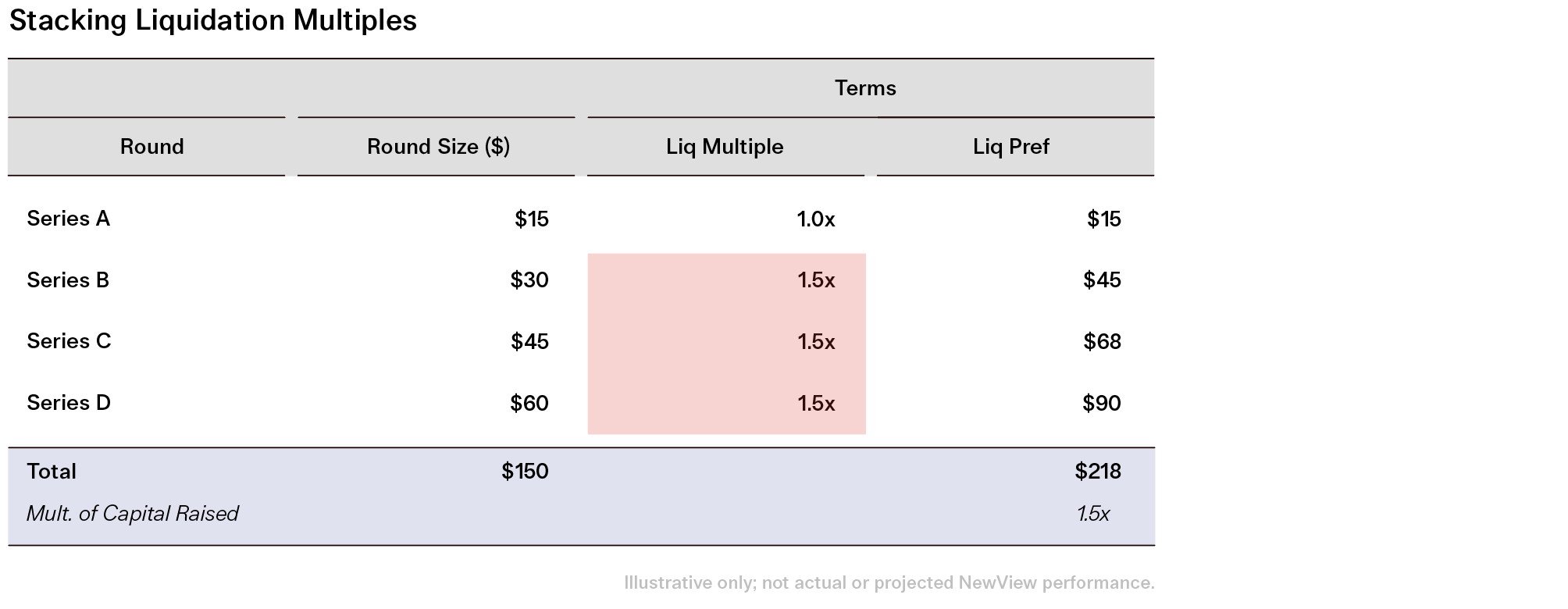
Preference that carries a multiple or accruing dividend, also referred to as structure, can have an outsized impact on other share classes at exit. Structure is more common in later stage rounds and includes preferred shares with liquidation preference multiples, accruing dividends, or PIK features that increase the contractual claim over time, raising the hurdle that the company must clear at exit.
These mechanisms serve to provide a minimum return to later stage preferred holders, but also create risks for subordinated equity holders. This becomes acute in three ways.
The company has an accruing preferred class and the timeline to exit extends, giving any accruing mechanism(s) more time to run its course.
The company needs to raise incremental primary capital. It’s unlikely that a subsequent investor will agree to terms with “worse” contractual claims or rights than a prior round.
Preferred shares have seniority and last money in is first out, leaving junior preferred holders exposed to greater residual risk. As a result, the most recently issued preferred shares are the safest position in the preference stack.

Our Approach
Straightforward, market-standard preference terms reduce structural risk and preserve the flexibility to raise additional capital without materially impairing outcomes for existing shareholders. Complex financing terms are not uninvestable, but should be underwritten accordingly.
3. Exit Timeline and Board Alignment
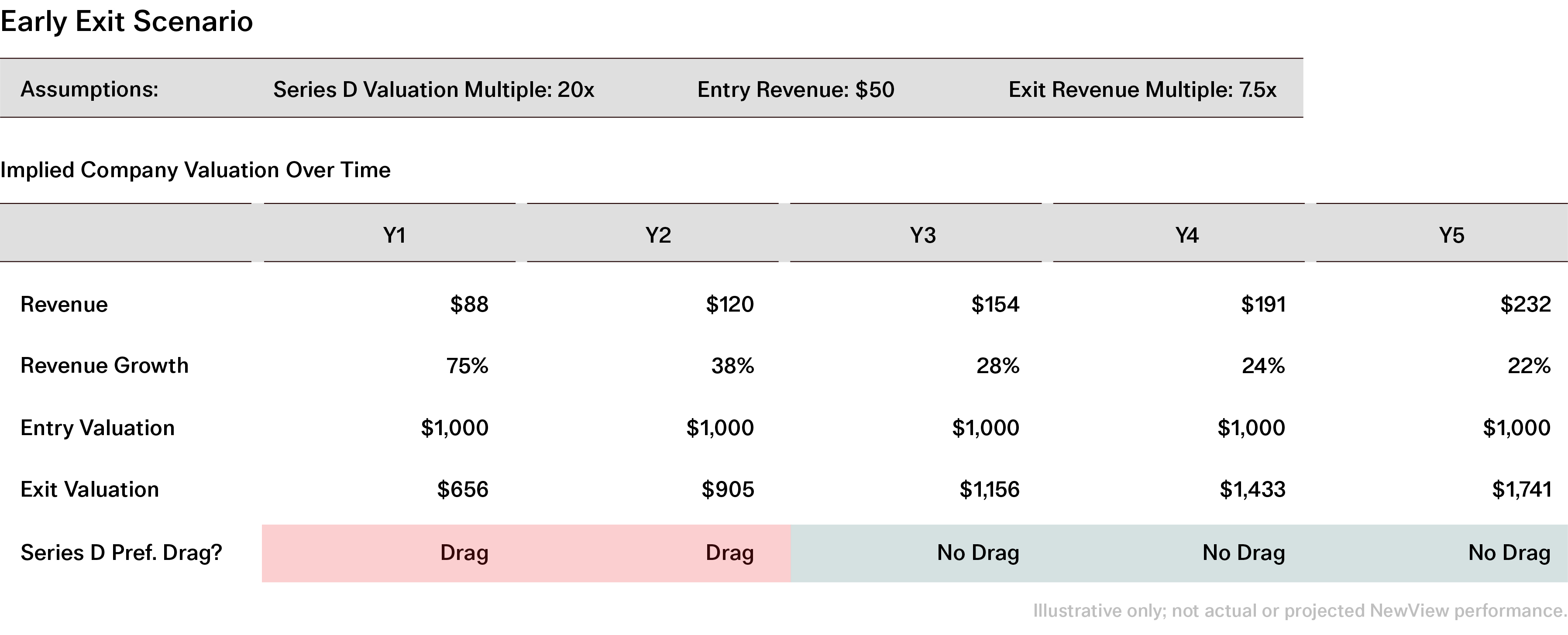
If a company is acquired earlier than expected, there may not be sufficient time for the business to grow into its preference stack. Venture-backed companies often command high valuation multiples based on strong growth expectations, which typically require time to materialize. An early M&A outcome can shorten that runway, particularly if the acquisition occurs at a lower valuation multiple than the company’s highest priced financing round.
Our Approach
We prioritize direct connectivity to management and board to gain firsthand perspectives on the company’s strategic plans, financing needs, appetite for liquidity, and motivations around potential exit timing. While these conversations do not eliminate timing risk, they help us better assess probability when underwriting.
4. Strength of Business Fundamentals
Beyond terms, business fundamentals are an important consideration when determining the economic impact of preference. In our experience, exceptional businesses are quick to outgrow preference overhang, while struggling companies rarely do. The rate at which enterprise value is created (and eventually realized) is directly correlated with preference risk. If enterprise value compounds faster than total preference, derisking happens over time. Conversely, capital-intensive businesses or companies with a longer path to cash flow breakeven may require additional primary or debt financing before exit. The current preference stack is only a snapshot; future financings can introduce new senior claims, structured terms, or rounds completed with limited valuation step-ups. These financings can compound preference overhang and shift more downside risk onto subordinated security holders, particularly when new capital enters ahead of existing shareholders or at valuations that do not meaningfully exceed prior rounds.
Our Approach
Investments in efficient, high-growth companies that compound enterprise value over time are more likely to outgrow their preference stack and can present attractive investment opportunities even in the case of sizable preference stacks.
Other Considerations
Exit path matters.
Preference risk is generally most relevant in an M&A outcome. When a company lists publicly, preferred shares typically convert into common stock, eliminating the liquidation preferences that would otherwise govern distributions in a private exit (though some late-stage rounds have IPO conversion hurdles). This does not eliminate the need to underwrite preference risk, but it does mean that the exit path matters when assessing how likely preference is to influence exit outcomes.
Detailed legal diligence is required.
Headline preference terms do not always tell the full story. While multiple, seniority, and participation are the primary economic terms, individual share classes can also have nuanced rights that affect how the preference stack is protected, modified, waived, or converted. These rights can matter immensely, especially in situations where certain classes have the ability to force or block conversion into common. For this reason, diligencing the governing documents and understanding the legal rights attached to each share class is a critical component of underwriting any new investment.
Underwriting Preference Risk
Because capital structure can materially affect investment outcomes, at NewView, we consider preference as one of many key inputs in our underwriting process, but not the only consideration. Instead of evaluating the preference stack based on its absolute size, we focus on the overall investment opportunity, with particular attention to relative multiples, the terms governing the preferred securities, and the incentives those terms create across investors, founders, and employees.
In some cases, companies with large preference stacks still represent attractive investments if they create value faster than their capital structure grows. Conversely, a modest preference stack does not eliminate risk if the underlying business struggles to compound. We rely on this framework to help us understand and appropriately price preference risk, rather than avoid it altogether.
Recent examples include:1
1. Early Exit
NewView acquired common shares in a late-stage company via a secondary transaction. The company was highly efficient and had not raised primary capital in over five years. While the company had a sizable preference stack, our analysis suggested it was unlikely that preferred shares would drag on proceeds for common shareholders across a variety of exit scenarios.
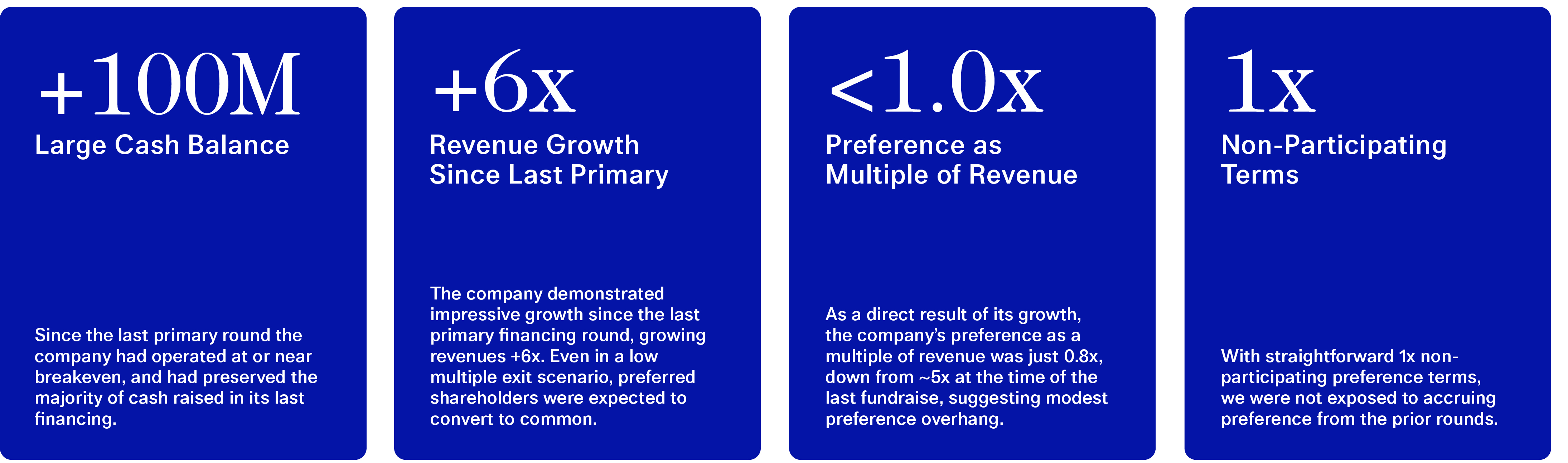
The company was acquired years ahead of our underwriting, which usually introduces early exit risk. In this case, however, we mitigated that risk at entry. We invested at a modest premium to a primary round completed more than five years earlier, while revenue increased more than 6x over the same period. The company also demonstrated efficient growth, with low burn and strong unit economics. As a result, common shareholders, including NewView Capital, received the same per-share consideration as preferred shareholders at exit.
2. Multi-Asset Transaction
In 2025, NewView Capital orchestrated a multi-asset secondary transaction in 11 companies, most purchased from a well-known GP. During our underwriting process, we analyzed the preference terms and multiples of each company, which are summarized below:
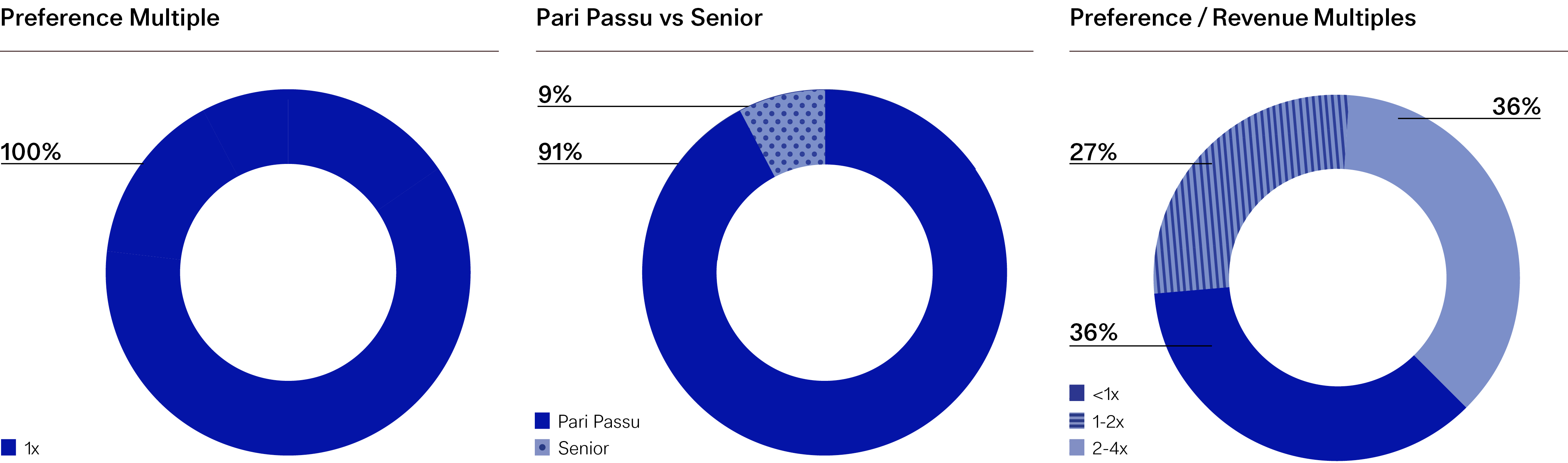
Across the portfolio, contractual terms were remarkably consistent, with nearly every company adopting founder-friendly preference terms: 1x liquidation preference, pari passu, and no accruing preference. This ultimately reduced the risk to common and early preferred shareholders. While a handful of companies had larger preference stacks relative to revenue (e.g., 2-4x revenues), the majority of companies in this position also raised capital recently and held significant cash reserves. Among the three companies with preference exceeding 2.0x revenue, the average cash balance represented approximately 47% of total preference. Together, these factors informed our underwriting and increased our confidence in the common and early preferred securities purchased.
3. Fundraise History and Preference as a Multiple of Revenue
The following chart illustrates the fundraising history of a NewView portfolio company and how its preference stack evolved as it raised additional capital. Preference as a multiple of revenue increases dramatically during periods of significant fundraising activity (see years four and five). This alone is not a reason for concern, as the company’s equity value also grew. This means on a relative basis (see grey line) the company’s relative preference stack each year stayed the same or decreased, reducing overall capital risk to common and early preferred shareholders.
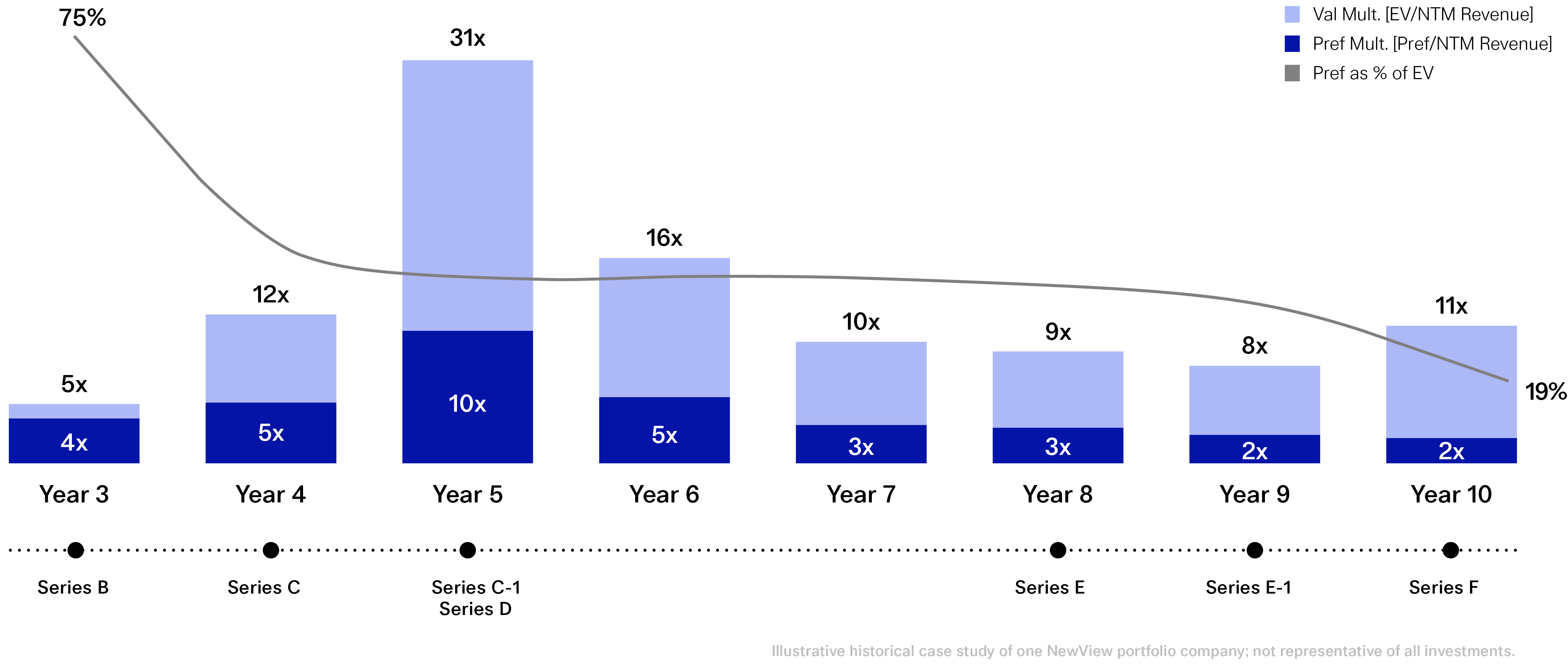
Between years 4 and 10, NewView purchased more than $75 million of common and early preferred shares across six distinct secondary transactions. During each investment, we evaluated the overall preference stack relative to company performance, total equity value, and the terms of the preferred shares issued, which gave us confidence in our secondary transactions. Purchasing secondary also allowed NewView to acquire shares at what we believed to be compelling discounts versus primary financing rounds.
In Summary
Liquidation preferences are a defining feature of venture capital, but they are not determinative on their own. Risk increases when a company’s capital structure becomes disconnected from business fundamentals: when preference represents a large claim on enterprise value, compounds over time, sits senior to earlier shareholders, or outpaces the company’s growth. At NewView, we underwrite these risks company by company, evaluating preference relative to revenue and total equity value, the specific terms of the preferred securities, the company’s cash position and financing needs, and ultimately the overall quality of the business, which determines the slope of value creation.
Our experience across more than 400 investments in over 90 companies reinforces this key point: preference is an important underwriting input, but rarely the sole (or even primary) driver of returns. We believe the strongest businesses tend to outgrow their preference stacks. An investor’s job is to identify those companies, understand the exceptions, and price the risk accordingly.
Appendix: Liquidation Preference Primer
Liquidation preferences are contractual rights that govern how a company’s proceeds are distributed during an M&A exit event. In private fundraising rounds investors receive priority over common shareholders in recovering their investment at exit, called liquidation preference. With each primary financing, new rights and preferences are established to provide downside protection to new preferred investors. This establishes who gets paid first, how much they receive, and under what circumstances those rights apply.
In general, preference is governed by three main terms:
1. Multiple, which refers to the amount a preferred investor is entitled to receive before common shareholders participate in the proceeds; the most common being 1x the original investment amount.
2. Seniority, which determines the order in which the different preferred investors are paid; terms vary between pari passu, which treats all preferred shares equally, or senior, which gives preference to the most recent money in.
3. Participation, which determines whether preferred investors can choose between receiving a set liquidation multiple (e.g., 1x), or converting to common shares to participate in the upside, or a combination of the two.
The preference associated with a typical Series B fundraise might look like this:
1x liquidation preference, pari passu, non-participating
Investors holding this share class are entitled to 1x the capital invested at the time the preferred shares were issued. At exit, proceeds are distributed pro-rata to all preferred shareholders as an aggregate share class, where preferred investors can either receive their preferred return (capped at 1x) or convert shares to common to participate in the upside.
While the preference associated with a late-stage crossover round could look like this:
1.5x liquidation preference, senior, full-participation
Investors holding this share class are entitled to 1.5x the capital invested at the time the preferred shares were issued. At exit, proceeds are distributed to preferred shareholders in the order in which they invested capital on a last-in, first-out basis before common shareholders are paid. Full-participation means that preferred investors receive their preference and their pro rata of any leftover proceeds alongside the common shareholders.

